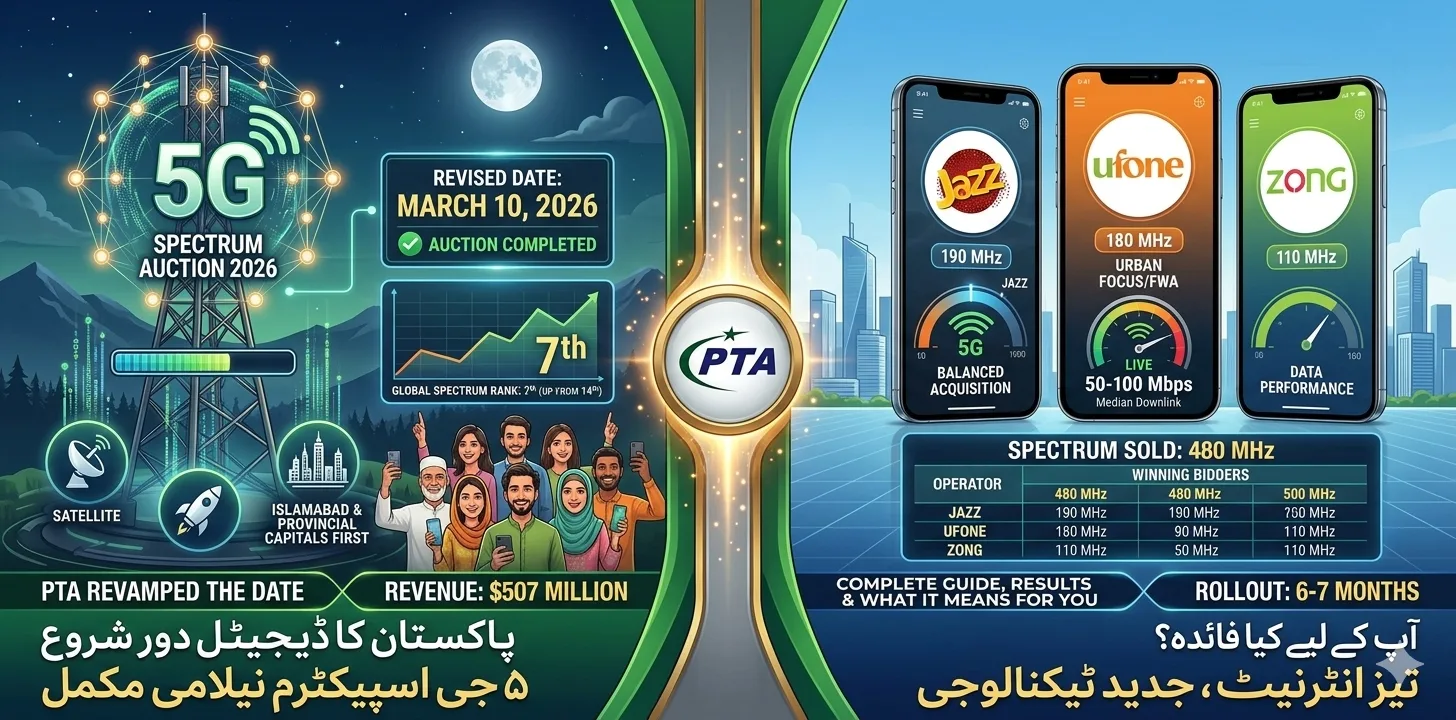
The Pakistan Telecommunication Authority (PTA) announced the new date for Pakistan’s 5G spectrum auction as March 10, 2026 , after revising the original schedule from February 26 , and on that historic day, Pakistan raised $507 million from Jazz, Ufone, and Zong, selling 480 MHz of spectrum across four frequency bands.
IT Minister Shaza Fatima Khawaja, PTA Chairman Hafeez-ur-Rehman, and Finance Minister Muhammad Aurangzeb presided over the live-broadcast auction, conducted with full transparency under PM Shehbaz Sharif’s directive.
Pakistan has now jumped from 14th to 7th place globally in total spectrum availability , leapfrogging Indonesia, Egypt, Turkey, Thailand, and Bangladesh. Commercial 5G services are expected to begin in Islamabad and provincial capitals within six to seven months. This is the complete guide , from PTA’s revised date announcement in January to auction results, operator-wise allocations, and what Pakistani users can actually expect.
Pakistan 5G Auction 2026 – Key Facts at a Glance
| Detail | Information |
| Original Auction Date | February 26, 2026 |
| Revised Auction Date | March 10, 2026 |
| Who Revised the Date | Auction Advisory Committee , chaired by Finance Minister Aurangzeb |
| Auction Conducted By | Pakistan Telecommunication Authority (PTA) |
| PTA Chairman | Hafeez-ur-Rehman |
| IT Minister | Shaza Fatima Khawaja |
| Independent Consultant | NERA Economic Consulting (International) |
| Total Spectrum Sold | 480 MHz (out of 597 MHz offered) |
| Government Revenue | $507 million (Rs. ~142 billion) |
| Auction Rounds | 3 rounds |
| Winning Operators | Jazz, Ufone (PTCL Group), Zong |
| 5G Rollout Start | Islamabad + provincial capitals within 6–7 months |
| Global Ranking (Post-Auction) | 7th globally (from 14th previously) |
| Official Contact | 5Gauction2026@pta.gov.pk | pta.gov.pk |
Why Did PTA Revise the 5G Auction Date?
Pakistan’s long-awaited 5G spectrum auction was officially pushed to March 10, 2026. The move delayed the nation’s entry into the 5G era but allowed additional time for bidders to prepare amid complex auction designs and spectrum pricing concerns.
Originally slated for February 26, 2026, the auction timeline was revised following an extensive review by the Auction Advisory Committee, chaired by Finance Minister Muhammad Aurangzeb and attended by IT Minister Shaza Fatima Khawaja. The committee assessed spectrum availability, procedural milestones, and stakeholder consultations to ensure a smooth auction process.
The revised timeline gave operators crucial additional weeks to complete qualification requirements and prepare their bidding strategies:
| Milestone | Revised Date |
| Information Memorandum Published | January 9, 2026 |
| IM Consultation Concluded | February 6, 2026 |
| Final IM Published | February 13, 2026 |
| Bidder Information Session | February 16, 2026 |
| Application + Pre-Bid Deposit Deadline | February 27, 2026 (4:00 PM PST) |
| Qualified Bidders Announced | March 3, 2026 |
| Mock Auction (Practice Session) | March 5, 2026 |
| Actual Spectrum Auction (Allocation Stage) | March 10, 2026 |
| Assignment Stage | March 12, 2026 |
| Performance Bank Guarantees Due | Within 15 business days |
Which Operators Qualified and Who Bid?
Three major telecom operators submitted applications to participate in the Spectrum Auction. These include Pak Telecom Mobile Limited (Ufone), Pakistan Mobile Communications Limited (Jazz), and CMPak Limited (Zong).
Each operator deposited the mandatory $15 million bid bond, making them eligible to participate in the auction. This brought total pre-bid earnest money to $45 million , signaling serious intent from all three telecom giants.
Notably, during the last spectrum auction, three telecom operators , Telenor, Jazz and Zong , had skipped the process due to tough terms and conditions, while Ufone was the only company that participated. However, this time Zong and Jazz also took part in the bidding and secured spectrum, reportedly due to more favourable terms set by the government.
Spectrum Bands Offered – What Was Auctioned?
The government offered spectrum across 6 bands, but buyers emerged for 4 bands. Under directives from the Ministry of Information Technology and Telecommunication, the PTA auctioned spectrum in the 700, 1800, 2100, 2300, 2600 and 3500 MHz bands, marking the largest spectrum release to date.
| Band | Use Case | Base Price (per MHz) | Lots Sold |
| 700 MHz | Wide-area rural & indoor coverage | $6.5 million/MHz | 2 of 3 lots sold |
| 1800 MHz | Enhanced 4G capacity | $14 million/MHz | No bids |
| 2100 MHz | 4G/5G mid-band | $14 million/MHz | No bids |
| 2300 MHz | High-capacity 5G | $1 million/MHz | All 5 lots sold |
| 2600 MHz | 5G capacity band | $1.25 million/MHz | All 19 lots sold |
| 3500 MHz | Core 5G services, Fixed Wireless Access | $0.65 million/MHz | 22 of 28 lots sold |
Why 1800 MHz and 2100 MHz had no bids: Operators already hold legacy spectrum in these bands. Buying more at $14M per MHz was considered too expensive given their existing holdings , a calculated decision, not market failure.
5G Auction Results – Operator-Wise Spectrum Allocation
In three rounds, the country raised $507 million by assigning 480 MHz of spectrum to Jazz, Ufone and Zong. Jazz bought 190 MHz, Ufone 180 MHz and Zong 110 MHz.
| Operator | Total Spectrum | 700 MHz | 2300 MHz | 2600 MHz | 3500 MHz | Amount Paid |
| Jazz | 190 MHz | 20 MHz | 50 MHz | 70 MHz | 50 MHz | ~$239M |
| Ufone | 180 MHz | , | , | 60 MHz | 120 MHz | ~$150M |
| Zong | 110 MHz | , | , | 60 MHz | 50 MHz | ~$118M |
| Total Sold | 480 MHz | 20 MHz | 50 MHz | 190 MHz | 220 MHz | $507M |
What Each Operator’s Strategy Reveals
- 🎵 Jazz , Most balanced acquisition. The only operator to buy 700 MHz low-band (critical for rural coverage and building penetration). Positioned for nationwide broad coverage with national reach.
- 📱 Ufone , Biggest bet on 3500 MHz (120 MHz). If execution is good, users in big cities could be pleasantly surprised. Heavily urban-focused; also eyeing Fixed Wireless Access (FWA) as a broadband replacement for homes.
- 🌐 Zong , Selective but strategic. Mid-band focus maintains its reputation for strong data performance while keeping spend disciplined.
Pakistan’s Global Spectrum Ranking – Before vs After Auction
Pakistan has moved to 7th position globally among comparable telecom markets following the conclusion of the IMT spectrum auction on March 10, 2026, significantly improving from its previous 14th position. With the addition of 480 MHz of newly auctioned spectrum, the country’s total assigned IMT spectrum has increased from about 274 MHz to nearly 754 MHz.
| Country Comparison | Total IMT Spectrum | Status vs Pakistan |
| Japan / Saudi Arabia | 1,300+ MHz | Well ahead |
| China / Brazil / Philippines | 900–1,200 MHz | Ahead |
| Pakistan (Post-Auction) | ~754 MHz | 7th globally |
| South Africa / India | ~700–800 MHz | Near peer |
| Indonesia / Turkey / Egypt | 600–700 MHz | Now behind Pakistan |
| Bangladesh / Thailand | <600 MHz | Behind Pakistan |
What the 5G Auction Means for Pakistani Consumers
This is the most important question , and most competitors only cover the auction, not the consumer impact. Here is the real story:
What Will Actually Improve
Under Phase 1 (2026–2028), operators must deliver a median downlink speed of 20 Mbps for 4G and 50 Mbps for 5G. By 2030, the 5G requirement jumps to 100 Mbps.
| Service | Current 4G (2026) | 5G Phase 1 (2026–2028) | 5G Phase 2 (2030+) |
| Download Speed | 4–15 Mbps average | 50 Mbps median | 100 Mbps median |
| Latency | 50ms+ | ≤50ms | ≤35ms |
| Web Page Load | 5–10 seconds | ≤5 seconds | ≤3 seconds |
| Video Streaming | 720p with buffering | 4K smooth | 8K/VR capable |
| 5G Coverage Cities | None | ISB + 4 capitals first | Nationwide push |
The Honest Reality for Most Users
Less than 2% of Pakistani mobile users currently own 5G-capable handsets, which cost between Rs. 40,000 and Rs. 100,000, putting them well out of reach for most consumers.
Pakistan’s mobile ARPU of approximately $1.10 per month, far below the global average of $8.20, makes the payback period deeply uncertain.
What this means for the average Pakistani:
- 📱 You need a 5G phone , if your handset cost under Rs. 40,000, you will not access 5G
- 🏙️ 5G starts in cities , Islamabad, Karachi, Lahore, Peshawar, Quetta; rural areas come later
- ⚡ Your 4G will get faster first , spectrum rationalization will improve 4G speeds noticeably before 5G arrives
- 🏠 Fixed Wireless Access is coming , Ufone’s 3500 MHz holdings suggest home broadband via 5G radio as an alternative to fiber
Key Policy Changes Alongside the Auction
The government abolished Right of Way charges for fiber deployment, reducing them from Rs. 36,000 per kilometer to zero, in a bid to accelerate infrastructure buildout.
Three other major policy shifts happening alongside the 5G auction:
| Policy Change | Impact |
| Right-of-Way charges abolished | Fiber deployment now free , drastically cuts infrastructure cost for operators |
| MVNO Policy Framework | New entrants can sell mobile services for $140,000 license fee , more competition |
| Mobile Device Manufacturing Policy 2026–33 | Import ban on used/refurbished phones; 50% local assembly target by 2033; Samsung/Xiaomi local production encouraged |
| Speed-Based QoS Benchmarks | PTA shifted from minimum to median speed requirements , operators held to realistic daily user experience standards |
Pakistan’s Telecom Evolution – From 1G to 5G
The evolution chart shows Pakistan’s mobile tech progression: 1G (1990s, voice only), 2G (2004, SMS), 3G (2014, data/video), 4G (2014, high-speed streaming), and now 5G (2026, IoT/AI/VR/smart cities/FWA).
| Generation | Year in Pakistan | Key Capability |
| 1G | 1990s | Voice calls only |
| 2G | 2004 | SMS, basic mobile internet |
| 3G | 2014 | Video calls, mobile data |
| 4G/LTE | 2014–2016 | High-speed streaming, apps |
| 5G | 2026 | IoT, AI, smart cities, FWA, VR |
Pakistan went from 3G/4G in 2014 to 5G in 2026 , a 12-year journey completed with a $507M investment that now places the country among the world’s top 10 in spectrum availability.
5G Economic Impact – Pakistan’s Digital Growth Story
IT exports for Jul–Dec FY26 reached $2.23 billion (+19.5% YoY), with December at $437 million. 5G could accelerate this by enhancing reliability for software houses and freelancers.
| Sector | 5G Impact Expected |
| IT Exports | Higher reliability for remote work, cloud computing, and software exports |
| Freelancing | Pakistan’s 1.5M+ freelancers gain faster, lower-latency connections |
| E-Commerce | $14 billion market projected , mobile shopping enhanced by 5G speed |
| Fintech | 15 billion digital transactions target by June 2026 , faster mobile payments |
| Telemedicine | Low-latency connections enable real-time remote consultations |
| Smart Cities | Islamabad and Lahore pilot projects , IoT sensors, traffic management, utilities |
| Agriculture (IoT) | Smart farming sensors, drone connectivity in rural areas long-term |
Frequently Asked Questions (FAQs)
Q: Why did PTA change the 5G auction date from February 26 to March 10, 2026? The Auction Advisory Committee, chaired by Finance Minister Muhammad Aurangzeb, revised the date after assessing spectrum availability, procedural milestones, and stakeholder consultations. The extension gave operators more time to prepare amid complex auction design and spectrum pricing concerns.
Q: How much did Pakistan raise in the 5G spectrum auction? Pakistan raised $507 million in the March 10, 2026 auction , selling 480 MHz of spectrum out of 597 MHz offered. Jazz, Ufone, and Zong were the three winning operators.
Q: Who won the most spectrum in Pakistan’s 5G auction? Jazz won the most with 190 MHz across four bands including 20 MHz in the critical 700 MHz band. Ufone won 180 MHz (focused on 3500 MHz), and Zong secured 110 MHz.
Q: When will 5G services launch in Pakistan? Commercial 5G services are expected to begin in Islamabad and the four provincial capitals within 6–7 months of the March 10 auction , meaning September–October 2026. Nationwide rollout will follow gradually.
Q: Do I need a new phone for 5G in Pakistan? Yes. You need a 5G-capable handset costing Rs. 40,000–Rs. 100,000+ to access 5G services. Standard 4G handsets will not work on 5G networks, though they will benefit from improved 4G speeds.
Q: Which operator is best positioned for 5G in Pakistan? Jazz has the most balanced portfolio (700 MHz for coverage + mid and high bands for speed). Ufone has the most aggressive urban 5G potential with 120 MHz at 3500 MHz. Zong maintains mid-band strength for data-focused users.
Q: Why did 1800 MHz and 2100 MHz bands receive no bids? Operators already hold legacy spectrum in these bands and considered the $14 million per MHz base price too expensive for spectrum they didn’t urgently need. This was a calculated business decision, not a sign of market weakness.
Q: How has the 5G auction improved Pakistan’s global ranking? Pakistan jumped from 14th to 7th globally in total IMT spectrum availability , from 274 MHz to 754 MHz. Pakistan now surpasses Indonesia, Egypt, Turkey, Thailand, and Bangladesh in spectrum availability.
Final Thoughts
Pakistan’s 5G spectrum auction on March 10, 2026 was a watershed moment , not just for the telecom industry, but for the entire digital economy. The PTA’s decision to revise the auction date from February 26 to March 10 ensured a smoother, more competitive process that ultimately delivered $507 million in government revenue, placed Pakistan in the global top 10 for spectrum availability, and set the stage for 5G commercial services by late 2026.
For everyday Pakistanis, the immediate benefit will be faster, more consistent 4G speeds , while true 5G experiences require both network rollout and affordable 5G handsets. Watch for service launches in Islamabad and provincial capitals by September–October 2026.
Official Resources:
- PTA Official Portal: pta.gov.pk
- 5G Auction Queries: 5Gauction2026@pta.gov.pk
- IT Ministry: moitt.gov.pk
- PTA on X (Twitter): @PTAofficialpk