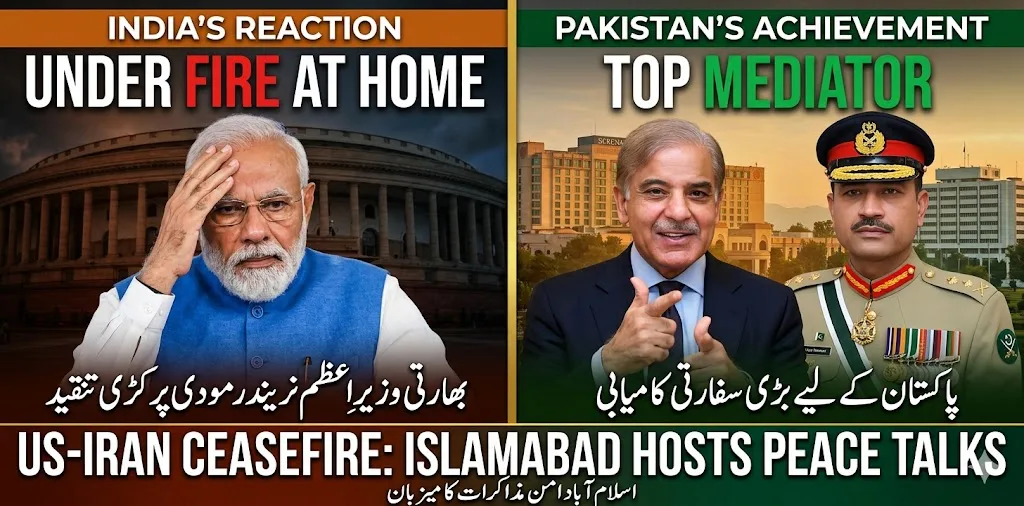
Pakistan has pulled off one of its biggest diplomatic achievements in decades , and India is not taking it well. India’s Congress party has termed Pakistan’s role in brokering a ceasefire between the United States and Iran as a serious setback to Prime Minister Narendra Modi’s foreign policy. As Islamabad hosts peace talks between two global superpowers, New Delhi is left on the sidelines , and the political storm inside India is growing louder by the day.
What Happened: A Quick Recap
The crisis began on February 28, 2026, when the US and Israel launched military strikes on Iran, killing its Supreme Leader and triggering a full-scale conflict. Iran shut down the Strait of Hormuz , through which 20% of the world’s oil passes , sending global fuel prices soaring.
Pakistan stepped in as a quiet but decisive mediator. Pakistani leaders, including Prime Minister Shehbaz Sharif and Army Chief Field Marshal Asim Munir, reportedly used back-channel communications to help de-escalate hostilities between Washington and Tehran. With no direct official ties between the US and Iran, Islamabad stepped in to relay messages, leading to a two-week pause in planned military actions.
US President Trump confirmed this directly, saying: “Based on conversations with Prime Minister Shehbaz Sharif and Field Marshal Asim Munir of Pakistan, and wherein they requested that I hold off the destructive force being sent tonight to Iran, subject to the Islamic Republic of Iran agreeing to the complete, immediate, and safe opening of the Strait of Hormuz.”
That statement alone tells you everything about Pakistan’s role , and India’s absence.
India’s Opposition Turns on Modi
The moment Pakistan’s role became public, India’s opposition parties went on the attack , and they didn’t hold back.
Congress General Secretary Jairam Ramesh took to X to attack Modi, stating: “The self-styled Vishwaguru stands thoroughly exposed, his self-declared 56-inch chest shrunk and shrivelled. His cowardice is demonstrated by his silence not only on Israel’s belligerence, but on the completely unacceptable and disgraceful language being used by his good friend in the White House.”
Ramesh didn’t stop there. He said Pakistan’s role in bringing about the ceasefire is a “severe setback to both the substance and style of Mr Modi’s highly personalised diplomacy.” He also pointed out that the policy to isolate Pakistan for its continuing support to terrorism had “clearly not succeeded.”
Senior Congress leader Salman Khurshid went further. He said Pakistan playing a mediating role “not only undermines the sustained efforts of successive Indian governments to diplomatically isolate Pakistan, but also affords Islamabad room to rehabilitate itself on the world stage, and thereby whitewash its track record.”
The “Vishwaguru” Image Takes a Hit
Modi has long promoted India as the “Vishwaguru” , a global teacher and leader. That image is now being questioned at home.
As Islamabad works towards peace in the world, Indian analysts are openly grieving the decline of Indian power in the region. The image of the Vishwaguru, constantly bragged about by Prime Minister Narendra Modi, is under fierce examination as Pakistan takes the lead in stability in the Middle East.
The irony is hard to miss. India has historical ties with both Iran and the United States. It had every tool to be the mediator. Analysts say the Iran war situation could have been a great opportunity for India to become a mediator, given its historical relations with both Iran and the US.
Instead, India chose silence.
How Modi’s Israel Visit Backfired
One specific decision is drawing intense criticism , Modi’s visit to Israel just days before the war began.
Congress also criticised Modi’s visit to Israel just two days before the war broke out on February 28, claiming the visit had diminished India’s global stature and standing.
By publicly aligning with Israel at such a sensitive moment, Modi left India with little credibility to act as a neutral mediator. Iran would not have trusted New Delhi to carry messages on its behalf after that visit.
Congress said Modi’s “partisan support for a far-right government on the eve of a war” contravened India’s traditional foreign policy approach.
BBC’s Verdict: India Diplomatically Sidelined
It’s not just Indian opposition parties saying this. International media has also weighed in.
The BBC, in an analytical report, observed that Indian Prime Minister Narendra Modi sought to diplomatically isolate Pakistan on the global stage, but instead found India itself increasingly sidelined. Pakistan’s proactive and effective diplomacy led to a 15-day ceasefire between Iran and the United States, with Islamabad set to host crucial peace talks between the two sides.
The BBC report underscored that while Modi aimed to corner Pakistan diplomatically, the outcome has been the opposite. India’s decision to overlook Pakistan’s mediation efforts has further weakened its own diplomatic relevance.
That is a damning assessment , and it came from one of the world’s most respected news organisations.
Pakistan’s Rise vs India’s Silence: A Side-by-Side Look
| Factor | Pakistan | India |
| Role in US-Iran ceasefire | Key mediator & host | Absent |
| Trump’s acknowledgment | Direct, public praise | None |
| Peace talks hosting | Islamabad (Serena Hotel) | Not involved |
| Global media coverage | Positive, major coverage | Criticism of silence |
| Diplomatic standing | Rising sharply | Under question |
| Opposition reaction | National pride | Sharp attacks on Modi |
Operation Sindoor: Another Open Wound
Pakistan’s diplomatic success has also reignited questions about Operation Sindoor , India’s military operation against Pakistan in May 2025 that ended abruptly.
Congress questioned the government’s handling of Operation Sindoor, saying its abrupt halt in May 2025 was never adequately explained.
Ramesh said Modi or his team “has never explained why Op Sindoor was suddenly and abruptly halted on May 10th, 2025 , the first announcement of which came from the US Secretary of State.”
For many Indians, Pakistan coming out stronger on the world stage just months after that episode feels like a double blow.
What This Means for India-Pakistan Relations
Pakistan’s emergence as a trusted global mediator significantly changes the diplomatic balance between the two neighbors.
Key takeaways:
- Pakistan’s isolation strategy has failed , India spent years trying to push Pakistan out of global forums. That effort has now backfired publicly.
- Asim Munir’s role elevated Pakistan’s military diplomacy. Direct communication between the Army Chief and Trump’s team was a game-changer.
- India’s “strategic autonomy” became strategic silence , New Delhi avoided taking positions, which meant it had no leverage.
- Pakistan has earned trust from both the US and Iran , That credibility took years to build and is hard to undo.
Pakistan has emerged as a credible mediator in a sensitive global crisis, earning the confidence of key international players including the United States, Iran, and China. As global leaders acknowledge Pakistan’s constructive role, India’s absence from the diplomatic forefront has become increasingly noticeable.
Deepfakes and Disinformation: A Warning
One important note: amid all the genuine criticism, false content is also spreading.
A viral video allegedly showing Indian politician Shashi Tharoor criticising Modi while praising Pakistan for its role in the ceasefire is doctored. The video has been dubbed over through AI and is not genuine. Tharoor himself confirmed there are alarming numbers of deepfake videos circulating of him.
Readers should verify content carefully before sharing , especially during high-tension geopolitical moments like this one.
Frequently Asked Questions (FAQs)
Q: Why is Narendra Modi under fire over the US-Iran ceasefire? India’s Congress party and other critics say Modi’s diplomatic approach allowed Pakistan to step in as the key mediator , a role that India, with its ties to both the US and Iran, was better positioned to play.
Q: What role did Pakistan play in the US-Iran ceasefire? PM Shehbaz Sharif and Army Chief Field Marshal Asim Munir held back-channel communications with both Washington and Tehran, helping broker a two-week ceasefire and securing Islamabad as the venue for peace talks.
Q: What did Jairam Ramesh say about Modi and Pakistan? Congress General Secretary Jairam Ramesh called Pakistan’s mediation role a “severe setback” to Modi’s highly personalised diplomacy and said the self-styled Vishwaguru stands “thoroughly exposed.”
Q: Did Modi visit Israel before the war started? Yes. Modi visited Israel just two days before the US-Israel strikes on Iran began on February 28, 2026. Critics say this aligned India too closely with Israel and damaged its ability to act as a neutral mediator.
Q: Is the viral Shashi Tharoor video about Pakistan real? No. The video showing Shashi Tharoor praising Pakistan over its ceasefire role is an AI-doctored deepfake. Tharoor himself has confirmed it is fake.
Q: How has Pakistan’s global standing changed after the ceasefire? Pakistan is now viewed as a credible diplomatic actor trusted by both the US and Iran. This marks a dramatic shift from its previously troubled international image.
Read More: Pakistan on High Alert as High-Level US-Iran Peace Talks Begin Today in Islamabad