
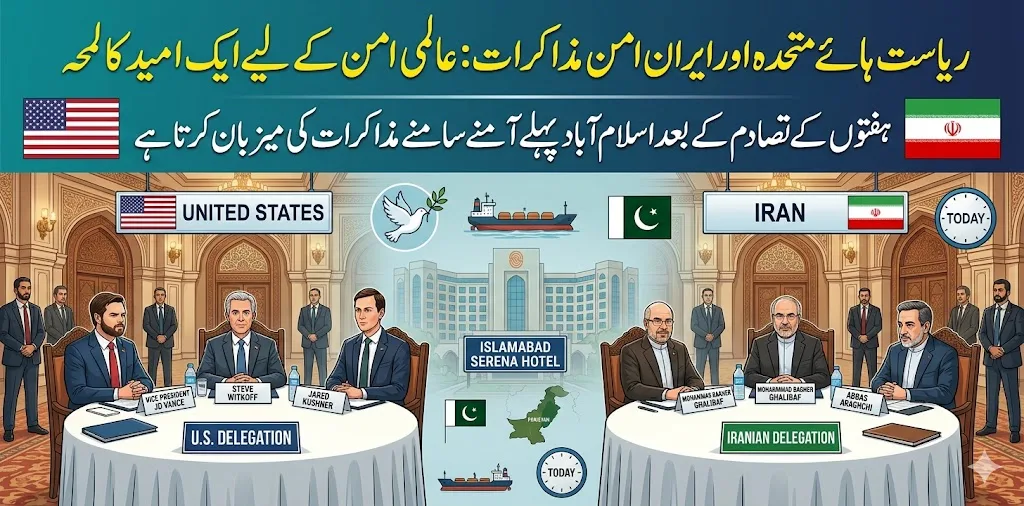
Pakistan is making history today as Islamabad hosts direct peace talks between the United States and Iran. After weeks of frantic back-channel diplomacy, high-level delegations from the United States and Iran have arrived in Islamabad for face-to-face talks aimed at turning a fragile two-week ceasefire into a lasting peace agreement.The world is watching closely , and Pakistan is right at the center of it all.
Background: How Did We Get Here?
To understand today’s talks, you need to know what sparked this crisis.
On February 28, 2026, Israel and the United States launched an air war against Iran, killing its supreme leader and many other officials, destroying a large number of military and government targets, and killing civilians. Iran responded with missile and drone strikes against Israel, US bases, and US-allied countries in the Middle East, and by closing the Strait of Hormuz, disrupting global trade.
The Strait of Hormuz is one of the most important waterways in the world. Through it passes a fifth of the global oil supply. Iran’s blockade sent oil prices soaring and rattled economies worldwide , including Pakistan’s.
After weeks of threats, counter-threats, and failed proposals, Pakistan stepped in. Iran agreed to a two-week ceasefire with the United States, with talks set to begin in Islamabad on Friday, April 10, 2026, based on Tehran’s 10-point proposal.
Pakistan’s Role: From Bystander to Peacemaker
This is a remarkable moment for Pakistan diplomatically. The country has gone from facing its own economic and security pressures to brokering a ceasefire between two global powers.
Pakistan shares a 900km border with Iran and hosts the world’s second-largest Shia Muslim population after its neighbour , factors that enhance its relevance to Tehran.
Pakistan is hosting the first direct talks between Washington and Tehran, working to end a weeks-long war that has left thousands dead and sent shockwaves across the globe. It is a stunning pivot for a country historically viewed through the lens of deep security concerns.PM Shehbaz Sharif played a key personal role. He said the goal is durable and long-lasting peace after the ceasefire, and Iran’s President Masoud Pezeshkian expressed appreciation for Pakistan’s efforts in a phone call with Sharif.
Who Is Attending the Islamabad Talks?
These are not low-level diplomatic meetings. Both sides have sent their most senior representatives.
US Delegation:
| Name | Role |
| JD Vance | US Vice President (Team Lead) |
| Steve Witkoff | Trump’s Special Envoy |
| Jared Kushner | Trump’s Son-in-Law & Senior Adviser |
Iranian Delegation:
| Name | Role |
| Mohammad Bagher Ghalibaf | Parliament Speaker (Team Lead) |
| Abbas Araghchi | Foreign Minister |
Vance’s expected visit marks a rare and significant level of US engagement in Islamabad. It is rare for a vice president to visit a country where the US doesn’t have an ambassador.
Read More: Prime Minister Youth Loan 2026 – Complete Guide to Apply Online
Where Are the Talks Being Held?
Islamabad’s Serena Hotel will host the delegations. Located next to the foreign ministry in the capital’s Red Zone, which houses key government buildings and embassies, the hotel has been requisitioned from Wednesday evening through Sunday, with guests asked to vacate.
The Red Zone is Islamabad’s most secure area, home to the Parliament, PM House, and foreign embassies. Turning it into a peace summit venue shows just how serious Pakistan is taking this responsibility.
Security Arrangements: Islamabad on Lockdown
Pakistan has left nothing to chance when it comes to security. The arrangements are unprecedented.
Extraordinary security arrangements have been put in place across the city’s Red Zone, key government buildings, the diplomatic enclave, and all entry and exit points. Law enforcement presence, including police and Rangers, has been heightened citywide, while the Army’s quick-response force is kept ready.
Key security measures include:
- Red Zone handed over to the Pakistan Army
- Rangers and police deployed throughout the city
- Public holiday declared on April 9 and 10 in Islamabad
- All entry and exit points to the capital sealed
- US Secret Service and CIA personnel on the ground
- Pakistan Air Force flying escort missions for Iranian delegation
- 30-member US security team already in Islamabad
The Pakistan Air Force mobilised its JF-17 and F-16 fighters, as well as IL-78 tankers and C-130 cargo planes. The fighters flew an escort mission for the Iranian representatives, with the PAF setting up a protective shield over Iran and the Persian Gulf for the Iranian delegation to travel to Islamabad.
What Is on the Agenda?
Both sides are coming in with very different positions. The gap between them is wide, but not impossible to bridge.
Iran’s 10-Point Proposal includes:
- Iranian oversight and dominance of the Strait of Hormuz
- Withdrawal of all US combat forces from the Middle East
- Halt to military operations against Iran-allied groups (Hezbollah, Houthis)
- Full compensation for war damages
- Lifting of all US, UN, and IAEA sanctions
US Position:
- The White House has claimed Iran is willing to surrender its stock of enriched uranium, described as a non-negotiable demand. Iran has not officially accepted that it is ready to give up its enriched uranium. Trump has called Iran’s 10-point plan “workable” as a basis for talks
What Does Pakistan Hope to Achieve?
Pakistan is being realistic about what can be achieved in one weekend of talks.
Pakistan is aiming for a realistic , if modest , outcome from the negotiations. The aim is to get the United States and Iranian negotiators to find enough common ground to continue talks.
Former Pakistani envoy Zamir Akram summed it up well: “Pakistan has succeeded in getting them together. We got them to sit at a table. Now it is for the parties to decide whether they are willing to make the sacrifices necessary to reach an eventual solution.”
Key Challenges That Could Derail the Talks
The path to peace is not smooth. Several issues could complicate or even collapse these negotiations.
1. The Lebanon Question Iran has repeatedly said the ceasefire covers attacks against Lebanon-based proxy Hezbollah. But Israel and the US have said the ceasefire does not include Lebanon. On Wednesday, just hours after the ceasefire came into effect, Israel launched its biggest wave of strikes in Lebanon, killing at least 303 people.
2. Strait of Hormuz By April 9, there was no sign that the agreement to lift the Iranian blockade of the Strait of Hormuz was being implemented, with ships once again being prevented from moving through the Strait.
3. Enriched Uranium Dispute Both sides are publicly claiming different things about Iran’s nuclear material. This could become a major sticking point.
What This Means for Pakistan
Beyond diplomacy, these talks have real consequences for ordinary Pakistanis.
- Fuel prices could drop if the Strait of Hormuz reopens fully
- Pakistan’s global standing rises as a trusted peace broker
- Economic benefits from improved ties with both the US and Iran
- Regional stability benefits Pakistan’s security environment
Pakistan’s proactive facilitation efforts and success puts it on the map as a player showing agency, establishing Islamabad as an active stakeholder in how the future of the broader region will look.
Frequently Asked Questions (FAQs)
Q: Where are the US-Iran peace talks being held? The talks are being held at the Serena Hotel in Islamabad, Pakistan, located in the capital’s Red Zone near the foreign ministry.
Q: Who is leading the US delegation in Islamabad? US Vice President JD Vance is leading the American team, joined by special envoy Steve Witkoff and Jared Kushner.
Q: Why was Pakistan chosen to host these talks? Pakistan shares a border with Iran, maintains working ties with both the US and Iran, and PM Shehbaz Sharif played a key role in brokering the two-week ceasefire that made these talks possible.
Q: What is Iran’s main demand in these peace talks? Iran’s 10-point proposal includes Iranian oversight of the Strait of Hormuz, withdrawal of US forces from the Middle East, lifting of sanctions, and compensation for war damages.
Q: Is Islamabad safe during these talks? Yes. Unprecedented security arrangements have been made, with the Red Zone under army control, Rangers deployed citywide, and a public holiday declared to minimize civilian movement.
Q: What is a realistic outcome from the Islamabad talks? Experts say the most likely outcome is an agreement to continue talks , not a full peace deal. A commitment to ongoing negotiations would already be considered a significant success.
Read More: PM Laptop Scheme 2026 – Apply Online, Eligibility & Full Guide