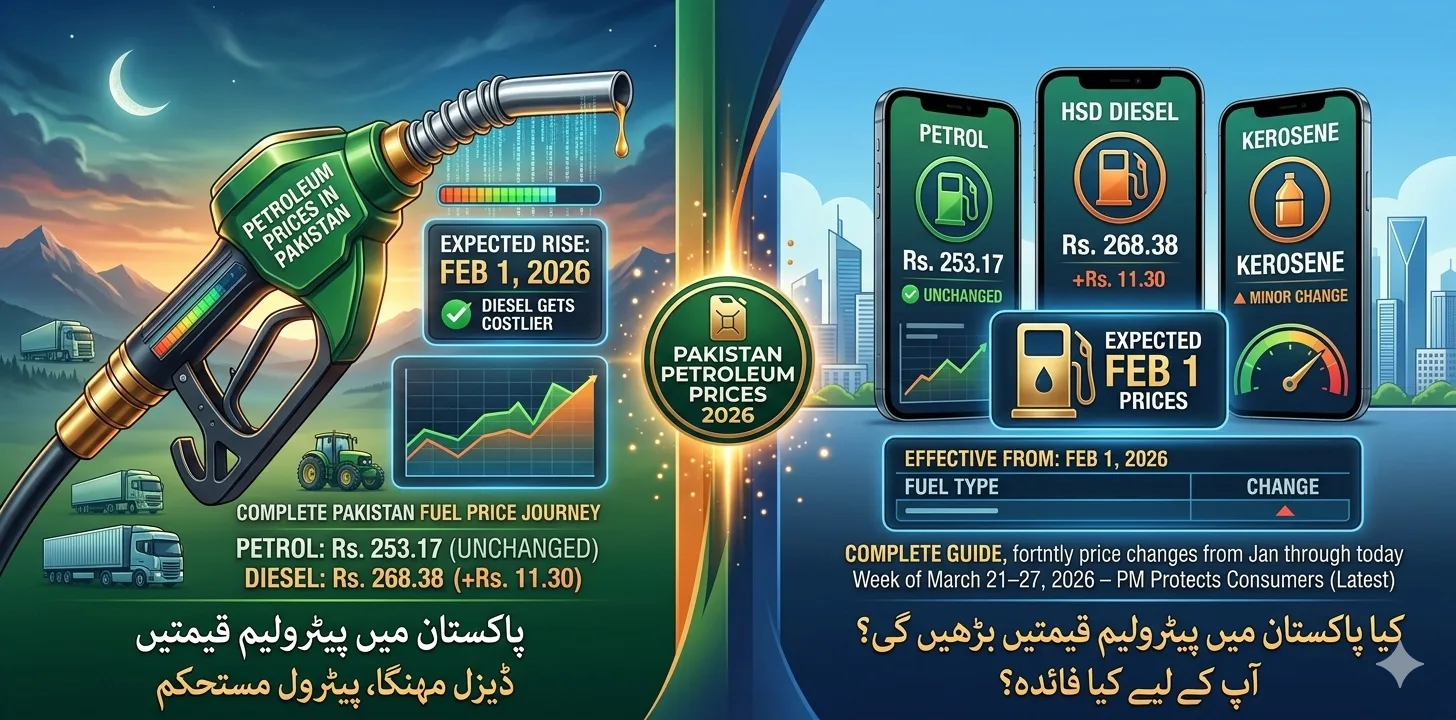
Petroleum prices in Pakistan from February 1, 2026 saw petrol remain unchanged at Rs. 253.17 per litre while High-Speed Diesel jumped Rs. 11.30 to Rs. 268.38 , exactly as pre-announced forecasts warned. That February diesel hike was just the beginning of a dramatic fuel price spiral.
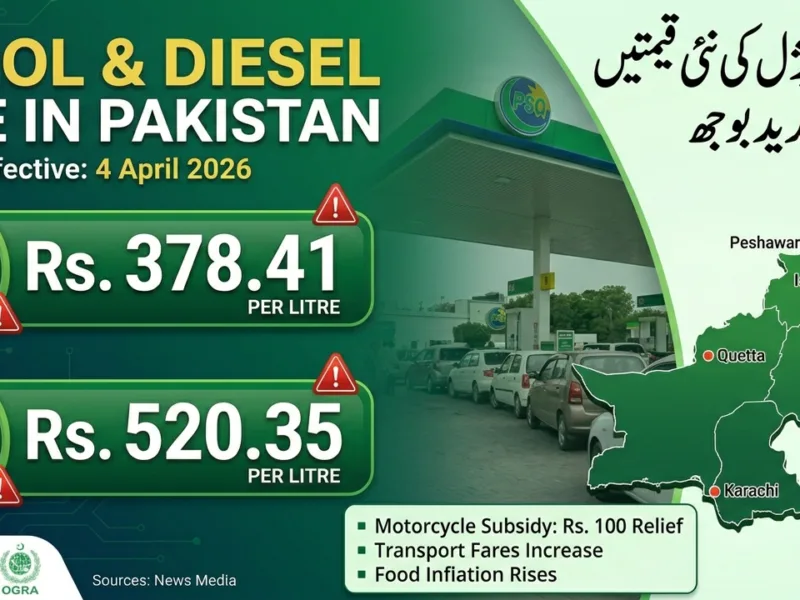
By March 7, 2026, the government announced a historic Rs. 55 per litre increase in both petrol and diesel , one of the largest single-session hikes in Pakistan’s history , pushing petrol to Rs. 321.17 and diesel to Rs. 335.86.
Today, the government is absorbing Rs. 48 billion to protect consumers from another Rs. 50+ hike. This complete guide covers every fortnightly and weekly price change from January through today, the exact reasons behind every increase, and what Pakistanis can expect next.
Petroleum Prices in Pakistan – Complete January to March 2026 Timeline
OGRA has published official notifications for every fortnightly period from January 1 through March 2026. Here is the complete, verified price history:
| Effective Date | Petrol (Rs./Litre) | HSD Diesel (Rs./Litre) | Change | Key Event |
| 21–27 Mar 2026 | Rs. 321.17 | Rs. 335.86 | Unchanged | PM rejects Rs. 50 hike; Rs. 48B subsidy |
| 14–20 Mar 2026 | Rs. 321.17 | Rs. 335.86 | Unchanged | Rs. 23B govt subsidy protection |
| 7 Mar 2026 | Rs. 321.17 | Rs. 335.86 | ▲ +Rs. 55.00 | Historic single-session hike |
| 1 Mar 2026 | Rs. 266.17 | Rs. 280.86 | ▲ +Rs. 8.00 / +Rs. 5.16 | Global market pressure |
| 16 Feb 2026 | Rs. 258.17 | Rs. 275.70 | ▲ Small increase | Mid-February revision |
| 1 Feb 2026 | Rs. 253.17 | Rs. 268.38 | Petrol unch; ▲ +Rs. 11.30 diesel | Diesel costlier as predicted |
| 16 Jan 2026 | Rs. 253.17 | Rs. 257.08 | Unchanged | Fortnightly freeze |
| 1 Jan 2026 | Rs. 253.17 | Rs. 257.08 | Unchanged | New Year stable |
| Dec 16, 2025 | ~Rs. 253.17 | ~Rs. 257.08 | Stable | Pre-2026 baseline |
| Sep 2023 (Record) | Rs. 331.38 | , | All-time high | Previous peak |
February 1, 2026 – What Actually Happened?
Reports before the announcement said the price of High-Speed Diesel was expected to rise by Rs. 9.47 per litre, while Light Diesel Oil could increase by Rs. 6.95 per litre. Additionally, kerosene oil was likely to see a price hike. However, petrol prices were expected to decrease by 36 paisas per litre.
The final official notification was different from the forecast:
The government decided to keep petrol prices unchanged, announcing the fortnightly petroleum rates for February. However, the government increased diesel prices by Rs. 11.30 per litre. Following this hike, the price of diesel climbed to Rs. 268.38. Meanwhile, petrol prices remained at Rs. 253.17.
February 1, 2026 – Official Fuel Prices
| Fuel Type | January 16–31 Price | February 1–15 Price | Change |
| Petrol (Motor Spirit) | Rs. 253.17 | Rs. 253.17 | ✅ Unchanged |
| High-Speed Diesel (HSD) | Rs. 257.08 | Rs. 268.38 | ▲ +Rs. 11.30 |
| Kerosene Oil (SKO) | Previous rate | Slight increase | ▲ Minor change |
| Light Diesel Oil (LDO) | Previous rate | Slight increase | ▲ Minor change |
The Petroleum Division stated that movements in petrol prices, supply factors, and demand conditions were carefully assessed before deciding to maintain existing fuel rates.
Why Did Diesel Get Costlier on February 1, 2026?
Three key factors drove the February 1 diesel increase:
1. Global Oil Market Pressure Pakistan’s petroleum prices faced changes amid ongoing global tensions and uncertainty in the international oil market. OGRA completed its work on the price adjustments and sent a summary to the Petroleum Division on January 30 for final approval.
2. IMF Conditions Pakistan submitted its projections for petroleum development levy collections over the next five years to the International Monetary Fund. The climate support levy will also increase by Rs. 2.5 per litre starting July 1, 2026. The IMF report includes year-on-year estimates of petroleum levy collections. For the current fiscal year, collections are projected at Rs. 1,468 billion, while for the next fiscal year, the estimate stands at Rs. 1,638 billion.
3. Differential Treatment of Petrol vs Diesel The government chose to protect petrol consumers (heavily used by motorcyclists and general public) while passing on the global diesel cost increase to commercial and industrial users , a politically calculated decision ahead of upcoming provincial pressures.
How Diesel Price Affects Every Pakistani
Diesel is extremely important for the economy. If diesel prices rise, transportation costs increase, which raises food and goods prices across the country. An increase in kerosene prices mostly affects low-income families.
| Sector Affected | Specific Impact of Diesel Hike |
| Long-haul freight trucks | Karachi–Lahore route costs up Rs. 3,000–Rs. 6,000 per trip |
| Agricultural tractors | Crop production costs rise , especially for wheat, rice, cotton |
| Tube-well operators | Irrigation costs higher , affects vegetable and crop pricing |
| Intercity buses & coaches | Operators push for 10–15% fare increases |
| Cold storage & logistics | Refrigerated transport more expensive , perishable food prices rise |
| Factory generators | Industrial backup power costs increase , passed to consumers |
March 1, 2026 – The Second Increase
The federal government announced new petroleum prices, confirming an increase in both petrol and high-speed diesel prices in an official notification. Under the revised rates, the price of petrol was raised by Rs. 8 per litre, bringing the new price to Rs. 266.17 per litre. High-speed diesel also became more expensive, with an increase of Rs. 5.16 per litre. The new price of diesel stood at Rs. 280.86 per litre.
| Fuel Type | Feb 16 Price | March 1 Price | Change |
| Petrol | Rs. 258.17 | Rs. 266.17 | ▲ +Rs. 8.00 |
| HSD Diesel | Rs. 275.70 | Rs. 280.86 | ▲ +Rs. 5.16 |
March 7, 2026 – The Historic Rs. 55 Shock
According to sources, the petrol and diesel price hike was decided in a high-level government meeting chaired by Deputy Prime Minister Ishaq Dar. The meeting included Federal Minister for Petroleum Ali Pervaiz Malik along with senior cabinet members.
Industry sources confirmed that the review process also involved consultations with other key federal ministers, including the Finance Minister, Commerce Minister, and Power Minister, before final approval of the new petroleum pricing structure.
The federal government announced a sudden Rs. 55 per litre hike in petrol and high-speed diesel, pushing fuel prices to record levels. This change directly affects transport costs, inflation, and daily household budgets.
| Fuel Type | March 1 Price | March 7 Price | Change |
| Petrol | Rs. 266.17 | Rs. 321.17 | ▲ +Rs. 55.00 |
| HSD Diesel | Rs. 280.86 | Rs. 335.86 | ▲ +Rs. 55.00 |
The announcement of the significant hike in petrol and diesel prices was expected to generate strong public reaction, with industry sources arguing that the hike would further strain household budgets, transportation fares, and commodity prices in the country. They noted that existing petroleum stocks, reportedly purchased nearly 24 days earlier at lower rates, may now be sold at the revised higher prices.
Why Did Prices Jump Rs. 55 in One Day?
Pakistan has been experiencing gradual increases in petroleum prices. Pakistan imports a large portion of its petroleum products. When global oil prices rise or the rupee weakens, domestic fuel prices also increase. The Oil and Gas Regulatory Authority (OGRA) proposes fuel prices, and the federal government approves the final rates.
Three forces caused the Rs. 55 surge:
- 🔴 Strait of Hormuz closure , Iran-USA conflict disrupted the world’s most critical oil shipping route, causing international crude to surge 50–70%
- 🔴 IMF pressure , The International Monetary Fund demanded Pakistan immediately pass on petroleum costs to consumers without subsidy
- 🔴 Petroleum levy restructured , The federal government increased the price of kerosene oil by Rs. 130.08 per litre. Similarly, light diesel was raised by Rs. 67.82 per litre. Levies are retained as revenue for government spending on infrastructure and public services. These levies are controversial, as experts argue that carrying high petroleum levies during a price spike increases the burden on consumers.
Government Switches to Weekly Reviews – A Major Policy Shift
A critical policy change that most competitors have completely missed: Pakistan shifted from a fortnightly to a weekly review cycle due to extreme global oil market volatility following the Strait of Hormuz closure.
| Review System | Old System | New System (Post March 7) |
| Review Frequency | Every 15 days | Every 7 days |
| Announcement Day | 1st and 16th of month | Every Friday night |
| Effective From | 12 AM on 1st or 16th | 12 AM every Saturday |
| Who Decides | OGRA + Petroleum Division | OGRA + PM direct approval |
| Reason for Change | , | Global price volatility too high for fortnightly gaps |
Week of March 21–27, 2026 – PM Protects Consumers (Latest)
The most important recent development , PM Shehbaz Sharif rejected a Petroleum Division proposal to raise petrol by Rs. 50 per litre and diesel by Rs. 74 per litre, absorbing Rs. 48 billion as an Eid gift. Combined with the previous week’s Rs. 23 billion subsidy, the total government fuel protection in just two weeks stands at Rs. 71 billion.
| Week | Proposed Hike | PM Decision | Cost to Govt |
| 14–20 March 2026 | Increase recommended | Rejected | Rs. 23 billion |
| 21–27 March 2026 | Petrol +Rs. 50, Diesel +Rs. 74 | Rejected | Rs. 48 billion |
| Total Subsidy (2 weeks) | , | , | Rs. 71 billion |
Without this protection, petrol would be Rs. 371/litre and diesel Rs. 410/litre today.
Pakistan Fuel Price Comparison – 2024 vs 2026
| Fuel | January 2024 | February 1, 2026 | March 21, 2026 | Total Rise |
| Petrol | ~Rs. 272 | Rs. 253.17 | Rs. 321.17 | Complex , dipped then surged |
| HSD Diesel | ~Rs. 285 | Rs. 268.38 | Rs. 335.86 | +Rs. 50.86 |
| Kerosene | ~Rs. 186 | Slight change | Rs. 358.01 | Massive increase |
| LDO | ~Rs. 179 | Slight change | Rs. 302.52 | Massive increase |
The highest petrol price in Pakistan was PKR 331.38 per litre, recorded on 16 September 2023. The current rate of Rs. 321.17 is approaching , but has not yet exceeded , that all-time record.
Petroleum Levy – The Hidden Tax Every Pakistani Pays
The government collects taxes on petrol and diesel through the Petroleum Development Levy. This tax is used to generate government revenue but also increases the price at the pump.
| Fuel | Petroleum Levy (Post March 7) | Change vs Before |
| Petrol | Rs. 105.37 per litre | ▲ +Rs. 20.97 from Rs. 84.40 |
| HSD Diesel | Rs. 55.24 per litre | ▼ -Rs. 20.97 from Rs. 76.21 |
| Kerosene Oil | Rs. 20.36 per litre | Unchanged |
| Light Diesel Oil | Rs. 15.84 per litre | Unchanged |
The petroleum levy on petrol alone at Rs. 105.37 per litre means nearly one-third of every rupee you pay for petrol goes directly to the government as tax , before any ex-refinery cost, OMC margin, or dealer commission is counted.
How to Reduce Your Fuel Costs in 2026
Until fuel prices stabilize, Pakistani citizens can manage their expenses by using vehicles efficiently, maintaining engines properly, and reducing unnecessary fuel usage.
Practical steps that actually work:
- ✅ Tyre pressure check weekly , under-inflation wastes 4–6% fuel
- ✅ Engine servicing every 5,000 km , clean filters and fresh oil = 10% better mileage
- ✅ Drive at 60–80 km/h on highways , optimal fuel efficiency zone for most Pakistani vehicles
- ✅ Turn off engine at 30+ second red lights , saves Rs. 200–400 monthly for daily commuters
- ✅ Carpool 3–4 days per week , cuts your fuel bill by 40–60%
- ✅ CNG for high-mileage vehicles , still 60–70% cheaper than petrol per km
- ✅ Consider switching to hybrid or electric , Honda HR-V hybrid and BYD now available in Pakistan
What to Expect Next – April 2026 Fuel Price Forecast
If global oil prices remain stable and the Pakistani rupee strengthens, prices may decrease slightly by Rs. 3 to Rs. 5 per litre. If international oil prices rise again, petrol and diesel prices may increase further.
| Scenario | Probability | Expected April Outcome |
| Strait of Hormuz reopens | Possible post-Eid | Petrol could drop Rs. 10–20/litre |
| Crude stays above $100/barrel | Likely | Government continues absorbing or passes on |
| IMF 5th review pressure | High (April review) | May force govt to reduce subsidy |
| PKR strengthens (Eid remittances) | Likely | Rs. 3–7 per litre relief possible |
| New Iran-US escalation | Possible | Fresh spike above Rs. 350/litre risk |
The next weekly review is Friday, 27 March 2026 , with new prices taking effect Saturday, 28 March 2026.
Frequently Asked Questions (FAQs)
Q: What were petroleum prices from February 1, 2026 in Pakistan? Petrol prices continued at Rs. 253.17 per litre, while high-speed diesel climbed to Rs. 268.38 after a Rs. 11.30 per litre increase. Petrol was kept unchanged while diesel got costlier , exactly as pre-announcement forecasts warned.
Q: Why did diesel get costlier from February 1, 2026? The HSD increase was driven by OGRA’s assessment of global oil market movements, with the Petroleum Division factoring in international price pressures and IMF fiscal conditions before issuing the February 1 notification.
Q: What is the current petrol price in Pakistan in March 2026? The current petrol price is Rs. 321.17 per litre and diesel is Rs. 335.86 per litre , effective from March 7, 2026. These rates are maintained through the week of March 21–27 via a Rs. 48 billion government subsidy.
Q: What was the biggest petrol price increase in Pakistan’s history? The government raised petrol and diesel by Rs. 55 per litre on March 7, 2026 , one of the largest single-session fuel price increases in Pakistan’s history.
Q: What is Pakistan’s all-time highest petrol price? The highest petrol price ever recorded in Pakistan was Rs. 331.38 per litre on 16 September 2023. The current rate of Rs. 321.17 is approaching but has not yet exceeded that record.
Q: How often does Pakistan revise petroleum prices now? Pakistan switched from fortnightly to weekly reviews after the Strait of Hormuz crisis in March 2026. New prices are announced every Friday night and take effect from Saturday midnight.
Q: Why did PM Shehbaz reject the Rs. 50 petrol hike in March 2026? The Petroleum Division recommended raising petrol by Rs. 50 and diesel by Rs. 74 per litre for the week of March 21–27. PM Shehbaz Sharif rejected the proposal as an Eid-ul-Fitr relief measure, directing the government to absorb Rs. 48 billion through the Prime Minister’s Austerity Fund instead.
Q: What is the petroleum levy on petrol in Pakistan? The petroleum levy on petrol is currently Rs. 105.37 per litre , increased by Rs. 20.97 from the previous Rs. 84.40 per litre on March 7, 2026. This levy is the government’s largest single revenue source from fuel taxation.
Final Thoughts
The petroleum price story from February 1, 2026 to today is one of the most dramatic chapters in Pakistan’s fuel pricing history. What began as a Rs. 11.30 diesel increase on February 1 , already concerning for consumers , cascaded through a Rs. 8 March 1 hike, and then exploded into a Rs. 55 March 7 shock driven by the Strait of Hormuz closure and IMF conditions.
Today, the government is shielding consumers with Rs. 71 billion in two-week subsidies , but the next weekly review on Friday, March 27 will determine whether that protection continues or gives way to market realities. Bookmark official sources and check every Friday evening for Pakistan’s latest petroleum price notification.
Official Sources:
- OGRA Notifications: ogra.org.pk/notified-petroleum-prices
- PSO Fuel Prices: psopk.com/en/fuels/fuel-prices
- PakWheels Live Rates: pakwheels.com/petroleum-prices-in-pakistan
- Petroleum Division Helpline: +92-51-9207114
Read More: AED to PKR Today – Latest UAE Dirham Rate in Pakistan (24 March 2026) | Open Market & Interbank